It’s day 4 of 5 for painting lessons week!
Have you learned anything new so far?
Hopefully at least one thing :)
I think understanding what to look for in a high quality paint brush is vitally important to a.) give you high quality results, and b.) prove to be a sound investment over significantly cheaper brushes.
With paint brushes you get what you pay for, hands down.
If you go to any major box home improvement store they have 4 types of brushes.
Economy, Good, Better, and Best.
Each of these serve a purpose.

Economy brushes shown above are great for quick projects that do not require a quality finish.
For example, glazing. You apply a glaze with a brush and then wipe smooth. These are perfect for applying the glaze because the finish for glazing is accomplished via the cloth when you wipe away excess, therefore it is rather unimportant how the initial finish appears.
I use economy brushes for touch ups, applying stain (sometimes), and other small projects.
I always prefer wooden handle brushes.
Wood absorbs moisture. If you are hot, your hands are clammy, and you are using a plastic handle paint brush, you can easily slip your brush and wind up painting something, or someone, you hadn’t intended ;)


“Good”, and “Better” paint brushes are a higher quality than the previously mentioned disposable brushes. The problem with these brushes, as with the economy, is that they shed and do not give you as fine a finish as a “Best” brush. When I say shed I mean they will drop bristles and you’ll have to use your fingers to pluck them out then go over that area again. If you are trying to achieve at specific type of finish this can be a major problem.
That is why I always use a “Best” quality brush. No (rarely) shedding, beautiful finish.

I have about 8 Purdy brushes in my arsenal.
Did I mention they last forever?
What to look for in a high quality brush:

Bristle length is important.
I was told by my “paint mom” that the bristles should always be longer than the width of the brush.
The longer the bristles, the more paint it can hold, the faster you can finish!

*Flexing* Haha I’m just kidding, I have no muscles.
It is important, however, that when you bend the bristles that they flex and snap back.
You want your bristles to be nice and tight and move all at once.
The ferrule (metal piece that holds everything together) should be made of metal and attached with some type of screw instead of the “slip on” kinds that will not hold your bristles as well. Less shed!

Bristle type. There are two primary types of bristles. Natural and Synthetic.
You should always use a natural bristle brush for oil based paints and varnishes.
Synthetic brushes are best for latex and water based paints.
The reason for this being that a natural bristle brush, when used with water based paints will soak up all the water and go limp providing you with no movement to help you paint. Additionally if the brush sags or droops it will make it particularly difficult to paint with.
Never use a natural bristle brush in water based paint!!
The purpose of bristle shapes:
There are two typical shapes (there are tons of brushes for specific purposes) that I want to talk about. Straight and Angled.

A Straight brush is for coverage.
Painting a large piece of furniture, a wall, or other project that will require a large space for paint.
These brushes are not very good for cutting and edging because of their lack of shape.

An Angled brush is for cutting and edging.
The angle of the bristles allows you to get into small spaces and crevices where a straight brush cannot go.
While you can use these for coverage, you will have more efficiency with a Straight bristle brush.
Typically I will use both of these types of brushes on one project.
When painting a wall I cut and edge around trim and ceilings with an angled brush.
When painting furniture I use the angled brush for detailed work,
and a straight brush to apply the overall coat.
Picking the right size for the job:

1″ brush is good for edging around windows, doors, and other trim work.
It allows you to be more precise because there is a small amount of bristles.
Especially good for tight corners and fine detail work.
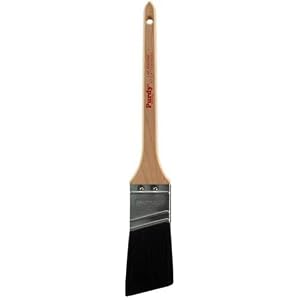
2″ brush is also ideal for corners and can offer good coverage for painting trim.
I use a 2″ brush for most of my furniture projects.
They hold a lot of paint so I can keep things moving and they provide a good amount of coverage.

3″ brushes are typically straight bristle and are primarily used for large surface areas.
They provide a high amount of coverage and can make large projects less time consuming.
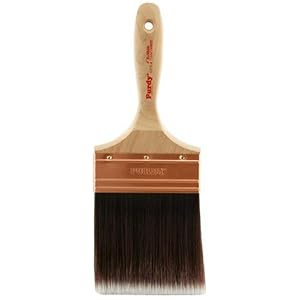
4″ brush is almost entirely used for high coverage over a large area like floors.
Whenever you are painting a project where there is little to no detail and a large amount of surface area to cover, a 4″ brush is going to be the best. Projects like fences, ceilings, walls and floors to name a few.
And that’s pretty much all you need to know!
Quality, Bristle Type, and Brush Size.
If I missed anything important please let me know, otherwise I’ll call this a wrap!
XOXO,
Rachel






Oh yes, I know how important it is to have the right brush! I learned the hard way, choosing a cheap brush too many times. lol
This comment has been removed by the author.
This is a wonderful series! I am beyond blessed to have a pro painter on hand at all times to answer my questions, and help out, but if I didn’t I would be at square one. Great tips!
I totally agree with your brush. I love painting furniture and certainly, brush takes really important place to make my result very well. The above picture of painting white color over furniture is expressing your thoughts in importance of brush. I like white color too much and really prefer white painted furniture as well for getting great look for my place. Anyway, thanks for your post with useful tips.
GREAT tips and wonderful job of adding pictures, sequencing, etc. Thanks SO much for your time and effort. I’m pinning this and hoping many, many people learn from your tips!
Only thing I think you might want to add is using Floetrol (sp?) to help keep brushstroke away. I’m betting you’ve used it and have some great insight for when and how to use it. Right?
Thanks again and I’m loving your blog.
You’re right, I have used it. Many times! It’s a wonderful product and I highly recommend it! Thanks for pinning :)